I Understanding the game
Number of players
Position of players
Scoring (The game in action)
Rotating for the serve
Serving
Substitution of players
II Individual playing Skills and Techniques
The underhand serve
Under-hand forearm pass
Volley
One-hand recovery
Forward Setting
Overhead setting
The attacking hit
The dink hit(Faint play)
Low spike
The
soft block
The hard block
The backward roll
The shoulder or side roll
The dive
I Understanding the game
Instead of trying to understand the skills and the game at the same time, it is far easier to understand how the game of volleyball is organised and then consider the skills.
In 1895 at Holyobe YMCA Gymnasium William Morgan, the Physical Director, invented a game in which an inflated basketball bladder was batted, by two teams, over a rope. Morgan wanted a simple game, which would be suitable for a variety of physical types both, fit and unfit, and which could be played almost anywhere. This game served the purpose and was dubbed “ Volleyball.” The game influence of the YMCA international movement, became known elsewhere. The 1939-45 War gave a great boost to the game, many soldiers learnt the game in training, and in 1947 the International Volleyball Association was formed.
In recent years tremendous progress has been made in the game all over the world. The introduction of volleyball to the Olympic Games in Tokyo in 1964 highlighted the popularity of this game throughout the world.
C
How
the game is played
Volleyball is a game played with an inflated supple leather or rubber ball and a high net. The ball is hit, with the hands, back and forth over the net without letting the ball touch the ground. It is a game between two teams of players each time occupying a court on one side of the net.
1.
Number of players
The number of players shall be six, whatever the circumstances. The composition of a complete team, including substitutes, may not exceed 12 players. A team with less than six players automatically forfeits the game.
At the time the ball is server the players of the two teams must be placed in their own court in two lines of three players; these lines may be broken ones. The players nearest the net are the front line players, the other three forming the back line. As soon as the ball is served each player may cover any section of his own court.
3. Scoring (The game in action)
The No 1 player serves the ball from outside the court into any part of the opponents’ court and the game begins. The receiving team can play the ball not more than three times on their side of the net before returning it to the opposite court - the ball may touch the net either in play or in service. The team need not play the ball three times, of course, and it may be returned advantageously after the first or second play. The player may not play the ball twice in succession. He may, however, play it a second time if one of his own side plays it in between. The rally continues until the ball is sent out of play, touches the ground, or is not returned over the net according to the rules. A player may play the ball even if he is not in court. The same player serves until his team loses service but both teams can score regardless of service. A game is won when one team leads by 2 points with a minimum of 25 points. If the score reaches 24-24 it is necessary to play to reach one of the following scores: 26-24, 27-25, 28-26, 29-27 etc.
4.
Rotating
for the serv
5.
Serving
6. Substitution of players
Substitution of players is made when the ball is dead on request of either the captain or coach of a team to the referee or umpire.. A team is allowed a maximum of 6 substitutions per game. Any player beginning a set of any match has the right to be replaced by any substitute and to re-enter the same set but only once and then only in his original place in the rotation. Furthermore, no other player except the one originally withdrawn may enter the set to take the place of a substitute.
II
Individual playing Skills and Techniques
Service is one of the most important factor in Volleyball. If you miss the service, it means you not only lose service to your opponent but they gain a point as well.
Prior to skills analysis of serving, remember the basic rules of serving. They are :
The ball must be tossed into the air before the server strikes it.
The player must hit or strike the ball with the hand or the arm.
The serve must fall within the boundaries of the opponents’ court (if not touched by an opponent), in order to be good.
The underhand serve
This serve is generally considered the least difficult to learn and to master. It is however, the least difficult for the opponents to handle. Beginning players should learn this serve first.
i) Stand facing the net, with the ball resting on the left hand
ii) The right hand is played behind the ball, and the right arm is straight as it swings back in a pendulum motion.
iii) As the right arm and hand swing forward to strike the ball, the server steps forward with his left foot.
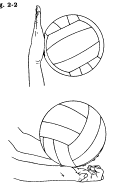
iv) The ball is struck with the heel of the right hand, after the left hand has dropped away or released the ball.
v) Hitting the ball slightly below centre, driving the heel of the hand hard into the ball, and the right arm follows through in the direction of the serve.

2.
Overhand serve (The floater)
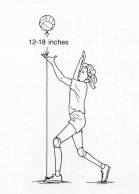
i) The ball is held on the left hand in front of and to the side of the right hand, which will be hitting the ball.
ii) The left arm is straight.
iii) The right arm is held back in a position with the thumb close to the right ear and the elbow away from the body.
iv) The ball is tossed into the air about two or three feet in front of the server.
v) The left foot moves forward as the right arm moves forward to a fully extended position and the right hand comes into contact with the ball.
vi) The heel of the right hand comes in contact with the ball at a point slightly below centre.
vii) To avoid spinning, the hand drives directly through the ball.
B
Passing
Volleyball is a game of passes. A volleyball team has no place for a weak passer. Since the ball must be hit or struck and may not come to rest on any part of the player’s body, it is imperative that a player learn to pass properly.
1. Under-hand forearm pass ( The dig )
This pass is used almost exclusively toady in the receiving of the serve, because it tends to lessen the possibility of error due to a “ held or caught “ ball on the receiving of the serve.
Using arms only, the ball rebounds forward without control.

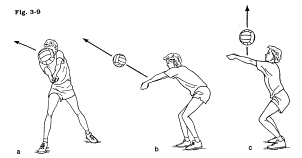
Using arms only, the ball rebounds forward without control.
Using the arms to absorb the ball and redirecting it upwards by using the legs. He is in better control.
The ball is hit with the forearms and not the fists.
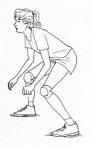
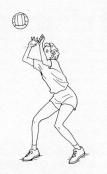
i) Feet are comfortably apart, knees bent, and one foot slightly ahead of the other.
ii) Hands are together, one hand placed into the palm of the other; arms are rigid and straight.
iii) Keep eyes on the ball to the point of contact with the forearms just above the wrist.
iv) Face the direction where the pass is to go.
v) All movement of the arms is from the shoulders, wrist and forearms do not bend at any time.
vi) The speed at which the ball comes to you will determine the amount of follow-through, if any.
2.
Volley
This is the most important pass to learn. It is the key to the game of volleyball.

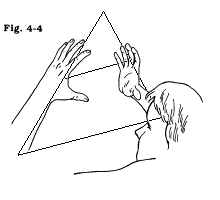
i) The hands are held with the fingers in a slightly curved position, thumbs pointing towards each other.
ii)
The ball is touched only with the finger-tips
and thumbs.
iii)
The
hands are held high and in front of the face.
iv)
The
arms are bent and the elbows points away from the body in a comfortable position.
v)
As
contact is made with the ball the hands move in toward the face to further cushion
the exception of the ball
vi)
The
pass is completed by extending the arms completely and
allowing the hands to come off the ball and
finish in the position of full extension.
vii)
AS
the ball is played the knees should bend; and as the pass is made, the knees
should straighten and the ankles extend.
viii)
Face the direction of your pass.
3. One-hand recovery
This is strictly a defensive pass. It is an important pass to learn since it is used a great deal in “ digging “ out hand-driven balls. This pass allows a player to extend his playing range considerably.
i) This pass is made with the single hand.
ii)
Keep low, watch the ball into the hand.
iii)
The
fist is clenched fully or the hand is left open with the fingers and thumb held
tightly together.
iv) The wrist is flexed slightly and the ball is played on the heel of the hand and the inside of the forearm or wrist.
v) Make solid contact with the ball
vi) The arm is kept rigid and the ball is allowed to bounce off the surface of the arm.
vii) Try to play the ball up into the air - don’t worry about direction.
The setter is the most important player in the team. The success of the team depends on the setter. Setter is like a conductor in the Orchestra. The setter must be a superior passer and ball-handler. It is of great importance that the setter learn to set a soft ball and an ability to judge the distance and height of the set-up he will make.
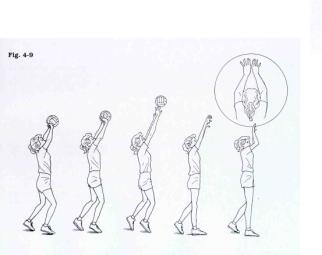
i) The setter usually moves under the ball.
ii) The foots are comfortably apart, with the knees bent and one foot slightly ahead of the other.
iii) The hands are held high and the eyes follow the ball into the hands.
iv) As the ball reached the hands, the knees bend and the hands cushion the ball.
v) The setter faces directly the spot where the ball will be set.
vi) As the pass for the setup is made, the follow-through is with the entire body – Arms are straight, hands follow through, knees straighten and there is a slight push off from the floor with the extension of the ankles.
2.
Overhead setting
i) The setter must have his back squarely toward the target – just the opposite of the forward pass.
ii) Initial positioning of the feet, body and hands be the same as in the forward pass.
iii) As the ball comes intro the hands, the setter arches his back and the ball is played back over the head.
iv) The ball does not roll off his fingers – it is directed by the movement of the hands over the head and to the rear.
D Spiking
In volleyball each team may hit the ball three times before it is returned to the other side. You can now appreciate the fact that the first two hits are used to control the ball, and the third hit is a full blooded attacking shot. It is this skill that makes the game exciting.
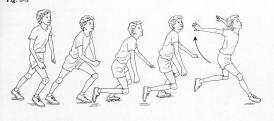
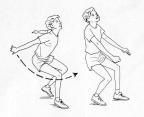
The attacking hit
(a) The
take-off and jump
i) The take off is usually accomplished with a minimum run of three steps.
ii) The use of the arms is the most important for maintaining good balance and getting a good lift at take-off.
iii) The take off is from both feet.
iv) The knees are bent to a full squat position, then extend completely, propelling the body upward.
(b) The
arm lift
i)
As the feet come together just prior to jumping,
the arms are extended fully to the rear.
ii) As the legs extend in the jump, the arms are brought vigorously forward and upward in a lift and reach motion.
iii) The arm swing cannot be over-emphasised in the development of a good jump.
(c) The
hit
i) As the spiker is on his way up, the right hand is “cocked” behind the right ear.
ii) The elbow is away from the side of the body and the back is arched.
iii) The spiker must hit the ball slightly above the center in order to drive it into the opponent’s court.
iv) As the heel of the hand is driven into the ball, the hand and fingers extend, imparting a down-spin to the ball as well as providing that extra power so necessary to complete a hard spike.
v) The follow through is in the direction of the hit but made so as not to touch the net.
vi) Always hit with an open hand – never with a fist.
(d) The
position of a ball
i) Hit the ball as high above the net as possible.
ii) The spiker’s take-off must be behind the ball and that the hit is made when the ball is in front of the spiker.
iii) The spiker must watch the ball at all times.
2. The dink hit (Faint play)
The dink as any other shot, must be clearly hit. It m ay not come to rest in the player’s hand. It has become more and more popular in top competitions.
i) Dinking is to play the ball with an open hand with fingers extended and slightly bent.
ii) The ball is played on the pads of the fingers.
iii) The spiker approaches the ball and takes off in the same manner he would in the execution of a normal spike.
iv) After the take-off, the hitting hand comes into the normal spiking position.
v) As the hand moves forward to contact the ball, it is slowed and the fingers are brought “softly” into contact with the ball.
vi) The ball should then fall to the floor just behind the blockers.
3. Low spike
A short of low spike is one hit just above the top of the net since the set-up is made very low.
i) In computing this hit, the approach is as the ball is in flight to the setter.
ii) The spiker is in the take-off position as the setter is making contact with the ball.
iii) The spiker jumps and the setter places the ball low just above the top of the net at a point directly in front of the spiker.
E Blocking
In order to cope with the powerful spikes that are being driven at the defensive team, the block evolved. The purpose of the block is to intercept the ball as it is hit at the net. There are two types or techniques of blocking.
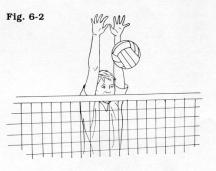


The soft block is done with the fingers held back and spread. The ball hits off the hands and travels to the defensive team’s court where the attempt a set-up and become the attacking or offensive team.
2. The hard block is accomplished with the hands and wrists rigid and parallel to the net. As the ball comes into contact, the wrists “break”, causing the hands to move forward and send the ball back into the opponents’ court.
Important tips :
i) Move into position quickly and parallel to the net.
ii) Position directly in front of the ball.
iii) The block is done with a jump upward. It is vitally important that no forward movement is made.
iv) Arms lift must be vigorously upward.
v) The arms are straight and the hands are pushed toward the ball.
vi) The fingers are spread and the hands are parallel to the net.
vii) The thumbs are almost touching as the pint toward each other.
viii) Do not block with the hands extended directly over the head.
F Defensive skills
Defensive skill in volleyball is becoming recognized as one of the most important aspects of a winning game. The skills employed in diving and rolling in volleyball are basically the backward roll, the dive and the shoulder or side roll.
1. The backward roll:
In order to complete a clean and successful two-hand chest pass or a bump, he must go low to the floor to complete the pass as he is falling backward.
2. The
shoulder or side roll:
The technique is used more often than the backward roll or the dive.
i) The ball is played low to the floor and usually with one hand.
ii) As the player extends his arm and hand to hit the ball, his momentum will carry him to the floor.
iii) To avoid injury, after playing the ball, bring his arm into his body and contact the floor with the back of his shoulder, as he rolls to a stop.
3. The dive:
This technique should be employed when a ball is seemingly out of reach.
i) Move to the ball.
ii) Hands together, begin the dive.
iii) Eyes on the ball, feet leave the floor.
iv) Arms fully extended, ball played on the forearms.
v) The ball is hit – arms drop to break fall.
vi) Hands in position to make contact with the floor.
vii) Hands in “push-up” position.
viii) The body is lowered slowly.
ix) The recovery is complete.
G
Receiving
the serve
The receiving of the serve properly and effectively is of utmost importance. Each error in receiving the serve may result directly or indirectly in the loss of a point.
i) Receive the serve with the underhand pass on both forearms just above the wrist.
ii) Keep the eyes on the ball and lift it up.
iii) In positioning a team to receive a serve, it should be noted that most services will land in the rear two-thirds of the court.
iv) Players receiving the service should position themselves to move as quickly as possible.
v) In completing the pass after receiving the service, it is essential that the ball is passed as high as possible to the setter.
[ Top Home Member list Volleyball learning tips Attire History Activities Y2001 Photo gallery Training schedule Emails to the coach and captain What's new ]